Forwardly-evaluated build systems
Some of the many caches that can be used to make build systems evaluate faster.
Build tools are very attentive to opportunities of caching build artifacts — that's a large part of their job. One area that is however neglected is caching of the evaluation needed to figure out what to build — even though in some of these systems that phase can be very slow! In Nix in particular, large monorepos can see evaluation times in the minutes, which substantially increases CI times. At the other end of the spectrum, smaller projects too soon hit UX difficulties with Nix as evaluation is on the critical path for commands like entering a devshell. There, shaving off even a couple dozen milliseconds matters.
In our own work on an alternative Nix frontend, we looked at various techniques for speeding up evaluation by caching. The results are very promising, and the techniques applicable in other projects.
Context
The Nix pipeline is roughly this:

A Nix expression is evaluated; the result should be a derivation datatype. Those are serialized into derivation files, which are the normalized build recipes. The builder then builds these and puts the resulting artifacts in the Nix store.
The derivation files constitute the interface between Nix-the-language and Nix-the-builder. Given this API, there is no reason why a different surface language couldn't be used.
A while back, we decided to try to make TypeScript the frontend language. It's familiar to a lot more people, and moreover, Nix has a lot of problems that come from being relatively obscure (it's slower, has less nice error messages, documentation generation is bad, LSPs aren't as advanced, etc.). The result was garn.
Our first version looked like this:

It created Nix strings in TypeScript, and then passed it on to the usual pipeline. The experience of writing garn files was great, but because of this extra step, everything was slower.
That's quite unfortunate, because slow Nix evaluation is already a problem. To fix this, the natural thing to do is to skip Nix evaluation entirely. TypeScript is a faster language than Nix, so that should be a good basis to start. We created a new TypeScript runtime that takes the V8 sandbox (via the great Deno/rustyscript libraries), removes almost all the primops that are side-effects (writing files, doing network fetches, random numbers), and put in just:
- readFile(file: string). Reads a file *from within the same directoryas thegarn.ts`/entrypoint file.
- path(path: string, { gitignore?: bool }). Given a directory, adds (potentially filtering) all files of the directory to a read-only copy, and returns the path of that copy (which is named by the hash of the contents).
- import(URL/file/git-repo: string). Read a file or git repo from a URL or local file path. If it's a remote file, add its hash to Garn.lock.
In other words, we made TypeScript be a pure and deterministic language if Garn.lock and the entire directory is considered as input. In fact, it is deterministic as a function of Garn.lock and exactly the files it reads during execution. (This observation, we'll see, is crucial: it means we can make the cache key depend on actual dependencies, rather than the entire repository.)
We've been calling this version garn2, though throughout this blog I'll refer to it as simply “garn” when that is not ambiguous.
Using TypeScript seems to have paid off — our baseline performance is quite good.
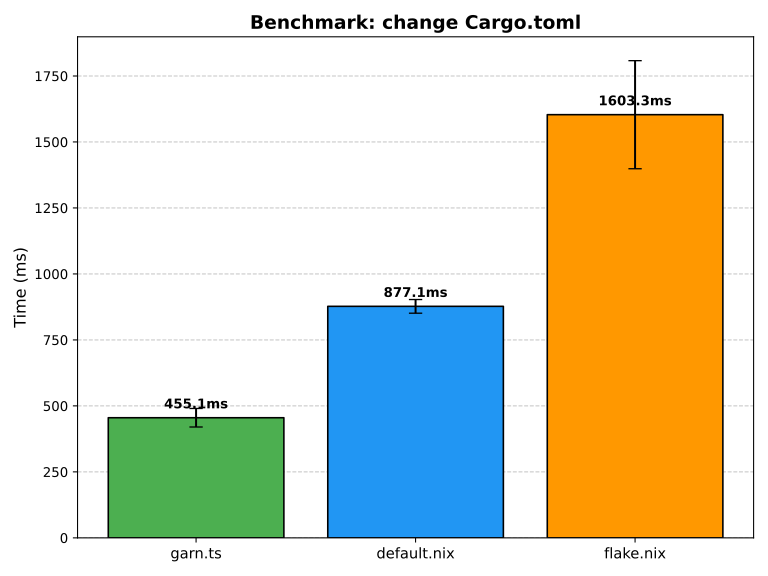
Benchmark 1: garn.ts (change Cargo.toml)
  Time (mean ± σ):     455.1 ms ±  35.1 ms    [User: 292.5 ms, System: 90.9 ms]
  Range (min … max):   413.4 ms … 530.5 ms    10 runs

Benchmark 2: default.nix (change Cargo.toml)
  Time (mean ± σ):     877.1 ms ±  25.8 ms    [User: 571.8 ms, System: 102.1 ms]
  Range (min … max):   836.0 ms … 928.3 ms    10 runs

Benchmark 3: flake.nix (change Cargo.toml)
  Time (mean ± σ):      1.603 s ±  0.205 s    [User: 0.721 s, System: 0.127 s]
  Range (min … max):    1.420 s …  1.972 s    10 runs
(A note on methodology: for each type of benchmark, we run the build first, so libraries etc. are imported. Then we change a source file, and time the build again (doing this 10 times each). We'll come back to why there's such a big difference between default.nix and flake.nix.)
The story of getting to that baseline is for another time. In this blog post we're going to improve that, specifically with caching.
Trace-based caching
Nix, when used with flakes, has a form of evaluation caching. It stores maps between repo state and flake output attributes to value; so if you evaluated packages.x86_64-linux.foo and it returns /nix/store/...-foo.drv, that mapping will be cached. If you again evaluated that same attribute, Nix won't have to compute it again.
This saves time, but only in the very narrow case where it applies. Most notably, if anything changes in the repository, all the caches are invalidated. Even if the change is to something completely unrelated to your evaluation, it will invalidate the cache.
This is annoying locally, but in CI, and especially for monorepos, this is a big missed opportunity.
Instead, what garn does is, on evaluation, keep a record of the hash of garn.ts, and of all reads that the evaluation did. If you imported something, or called path or readFile, that's tracked. The result is also cached at the end.
On subsequent runs, garn checks whether it has a cache for that version of garn.ts. If it does, it checks what reads the last run did, and whether the results are all the same now. If so, it returns the cached value. It's safe to do this because garn scripts are as pure as a function of those inputs.
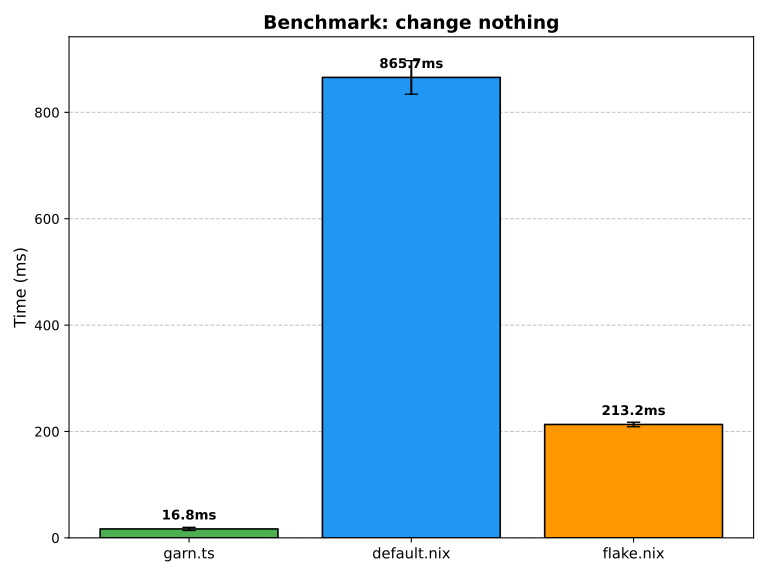
Benchmark 1: garn.ts (change nothing)
  Time (mean ± σ):      16.8 ms ±   3.0 ms    [User: 4.4 ms, System: 12.5 ms]
  Range (min … max):     9.9 ms …  22.7 ms    39 runs

Benchmark 2: default.nix (change nothing)
  Time (mean ± σ):     865.7 ms ±  31.5 ms    [User: 581.1 ms, System: 100.4 ms]
  Range (min … max):   812.8 ms … 914.5 ms    10 runs

Benchmark 3: flake.nix (change nothing)
  Time (mean ± σ):     213.2 ms ±   4.2 ms    [User: 54.6 ms, System: 24.0 ms]
  Range (min … max):   206.6 ms … 219.2 ms    10 runs
garn takes about 2% of the time default.nix does, and 7% of the (also cached) flake.nix!
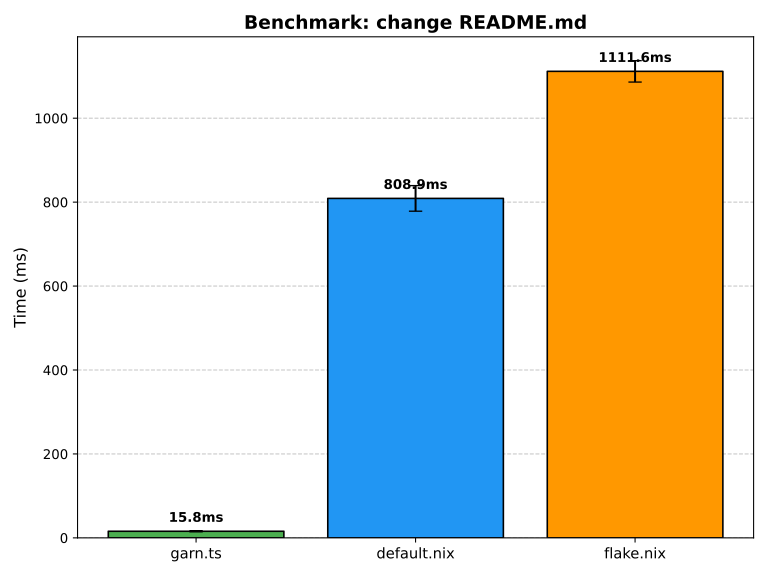
The above is a comparison of evaluating when nothing has changed. But for garn, the cache is only invalidated when it should be. If you have a package that only reads some directories or files, and imports only certain modules, it will retain its evaluation cache if only other things change.
Benchmark 1: garn.ts (change README.md)
  Time (mean ± σ):      15.8 ms ±   1.4 ms    [User: 4.3 ms, System: 11.8 ms]
  Range (min … max):    11.4 ms …  18.4 ms    44 runs

Benchmark 2: default.nix (change README.md)
  Time (mean ± σ):     808.9 ms ±  30.5 ms    [User: 572.8 ms, System: 103.2 ms]
  Range (min … max):   753.2 ms … 849.0 ms    10 runs

Benchmark 3: flake.nix (change README.md)
  Time (mean ± σ):      1.112 s ±  0.026 s    [User: 0.728 s, System: 0.119 s]
  Range (min … max):    1.089 s …  1.171 s    10 runs
(In the repo we are benchmarking, flatbuffers, 97% of commits don't touch the Rust code. The flake.nix cache is not helpful for 100% of commits; the garn cache is valid for 97% of them. The percentage won't always be this high, of course.)
When you have large projects where evaluation alone is huge, that's a big deal, not just in terms of time, but also in terms of the memory usage you can save.
This cache avoids even entering the V8 runtime entirely. But there's a downside to it: if certain computations that are expensive are used by two different outputs (e.g., garn build foo and garn build bar both compute some baz), the cache won't be reused between them. (The Nix flake cache also suffers from this.) We'll return to this.
This isn't a new idea. fabricate, memoize, rattle and others have based build systems on tracing effects. Spall et al (2022) call these build systems forward build systems; unlike Make and the like, they don't reason backwards from a target, satisfying its dependencies, but instead run the build script forwards once, keeping track of its dependencies. Most of them use strace or the like (on Linux) to observe these dependencies or side effects. The ideal is that you can run an unmodified program (e.g. a bash script) and get an automatically cachable version of it. The possible side effects in an arbitrary Linux program are, however, huge, and keeping track of them efficiently and correctly is quite difficult. This is even harder to do in a cross-platform way. As a result, these programs fall somewhat short of their ideal. With garn, on the other hand, we keep track of side-effects at a language level, which is much easier to do and do correctly.
These programs are also about forward builds; what garn is doing is using tracing at evaluation time, to figure out what the build recipe is.
Adding incrementalism
There's a pattern that a lot of big Nix repos use to bring down their evaluation time that would be abominable if it weren't necessary. It's moving evaluation into IFDs so that the evaluation is cached as a build artifact. There are a few ways of doing this, but one is to check the output of nix eval <expensive computation> to your git repo, regenerating as needed. Then you have your Nix code import that.
The problem isn't only that keeping generated code in your repo, and keeping it up-to-date, is a pain. It's also that the existence of IFD itself negatively affects the performance of evaluation. Suddenly you have to spin up a whole sandbox, and potentially install in it a lot of software, to calculate some value. This is made worse by the fact that there is no concurrency and very little parallelism in Nix (in evaluation, at any rate). Moreover, because Nix builds are only “best-effort” deterministic (not doing anything about non-determinism introduced by parallelism, for example), IFD degrades the determinism of evaluation to that otherwise-lower level one of builds.
But there is an important idea there. It's to split the expensive computation into parts, so that one part depends on as little as possible, so as to get a form of incrementalism. After all, even if our previous cache was precise, in that it didn't invalidate a computation unless it really had to, it was all-or-nothing: either the entire computation was cached or none of it.
Our approach to supporting a form of user-guided incrementalism was to provide language-level access to something very similar to the cache mentioned in the previous section. The API is via a function memoize, that takes two arguments: a file with a main function to be memoized, and the arguments to call it with. The file can have imports, or read files, just like everything else. (It can even itself call memoize!). Additionally, it can call getArgs to get its arguments. These effects are tracked as above. On rerun, if its reads didn't change, the result can be taken from the cache. Because it is a separate file, it is easy to prevent mutable variables from being shared between the computation that's memoized and the world outside (which would compromise cache correctness). (This is in fact the same reasoning that led Web Workers to being designed the way they did, as a separate script. The motivation there relates to parallelism rather than memoization, but the solution is the same. Indeed, our memoize uses web workers, which has the added advantage of providing more opportunities for parallelism.)
This approach of tracking getArgs as an effect, we realized, makes it possible to solve the problem we encountered earlier, of the cache not being shared between different computations. The original design of garn makes the available targets be whatever derivations/packages you happen to export; garn does the job of matching the name you provided in the command line (e.g., foo in garn build foo) with a variable your garn.ts exported. But we could instead provide a getTarget function which returns the target and track its usage as an effect. Any calls to memoize that happen before getTarget won't be invalidated (if none of the other reads changed).
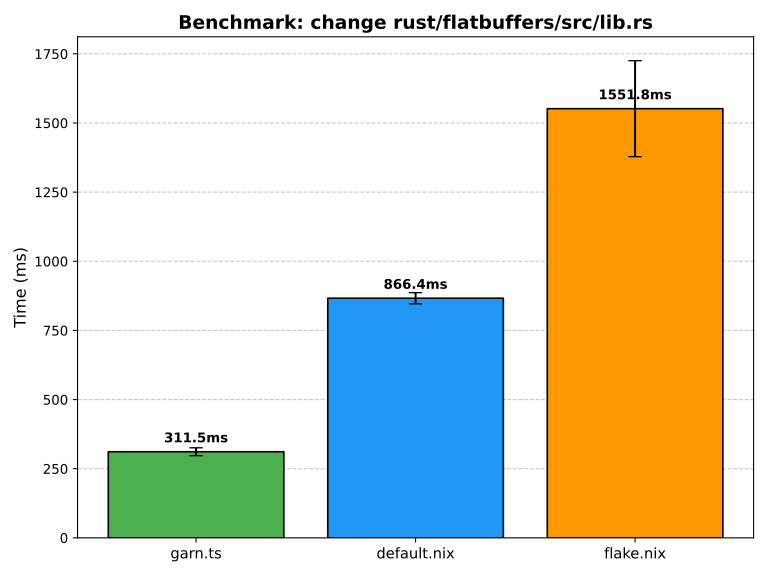
The results:
Benchmark 1: garn.ts (change rust/flatbuffers/src/lib.rs)
  Time (mean ± σ):     311.5 ms ±  14.2 ms    [User: 227.6 ms, System: 76.3 ms]
  Range (min … max):   283.9 ms … 330.7 ms    10 runs

Benchmark 2: default.nix (change rust/flatbuffers/src/lib.rs)
  Time (mean ± σ):     866.4 ms ±  20.2 ms    [User: 570.0 ms, System: 97.2 ms]
  Range (min … max):   836.4 ms … 892.5 ms    10 runs

Benchmark 3: flake.nix (change rust/flatbuffers/src/lib.rs)
  Time (mean ± σ):      1.552 s ±  0.173 s    [User: 0.715 s, System: 0.128 s]
  Range (min … max):    1.402 s …  2.006 s    10 runs
About 70% of the time of the uncached version (which was, as a reminder, 455ms), and nearly one fifth of flake.nix. Not bad, but not as fast as the fully-cached computation, which was in fact 10x faster.
This is as far as we've implemented caches. But let's consider what could be improved next.
Partial evaluation
There are few reasons for this difference:
- You have to spin up the whole V8 VM since there is stuff to do before and after getting the memoized value.
- You actually have to do (i.e., compute) that stuff
- What's in the cache could be quite big, and storing and retrieving that takes more time
- You then have to pass a relatively big datastructure from TypeScript into Rust, and let it be processed.
If you're trying to get the eval down from a few minutes to a few seconds or a few hundred milliseconds, that might not be relevant; but if you also care about going down to tens of milliseconds, it matters a lot.
If you look at most stacks, they follow a common pattern: there are a couple of files (Cargo.toml, Cargo.lock, package.json, package-lock.json, <project>.cabal, etc.) which determine almost everything about the resulting derivation — i.e., of the build — except what source files are in the directory when the build kicks off. Almost all the work that happens during the evaluation doesn't need to know about the actual source. It also happens that those config and lock files change much more rarely than source files themselves.
In essence, we have something like buildPackage(configFiles, src) -> Derivation, but it's possible to split it into buildPackageBuilder(configFiles) -> (src -> Derivation) such that all the expensive work happens by the time the first function returns. If we could in this way partially evaluate buildPackage and then cache the result, we would have evaluations that are essentially instantaneous unless a config file changes. Caching e.g. a parsed config file might only be part of the computation that's independent of src, and it's not always easy to refactor things to include more of it. But if we could return the partially evaluated function, things would be much easier.
Functions aren't serializable, at least not easily; since the cache is persistent, that means we can't cache the function itself.
The “common” case is that we return a datatype (the derivation) that doesn't vary structurally based on the source, but only in the values of certain primitive fields (mostly strings/paths). So when user code returns a value that has a source path, we can figure out where in that value the source is used (by diffing two versions of it, by just inspecting the string, or by more reasonable but involved techniques such as keeping metadata of usage, sort of like “taints”). We can then in the Rust side do as much processing as doesn't touch that value (adding dependency derivations and calculating hashes), and then store just the remainder, with a pointer to what needs to be changed. We even control the length of the string, so it might even be possible to operate directly on the bytes of the persisted data.
The problem we had is that calls to path invalidate the cache, even though usually the path is just a build-time dependency (in the sense that the derivations generally produced when paths differ differ only by substitution of one path by the other; there's no branching or parsing of the store path going on). We came up with a technique for very fast caching in case that assumption of how path is used is true. To make this safe, the type returned by path must be opaque so it can never be inspected.
The upside of all this is a fast cache that does not get invalidated by calls to path, and which requires no change from the user's side. All of that is quite a bit of work, however. So far we've been treating this version of garn as more of an exploration; most of these caches took only a couple of days to implement. Likely we won't continue in this direction for now, but it's good to know the option exists.
Conclusion
Here are all the results gathered together:
Not bad.
Though this version of garn can already build itself, it is by no means ready for production, and not only because of missing features. It's an experimental implementation, about exploring ideas more than being production-grade. (It also involved a fair bit of LLM code.) The code itself can be found here.
Besides caching, there are lots of ways performance can be (or has been) improved. A lot of these are also really exciting.
In theory a lot of these improvements could be ported to Nix as well: Nix-the-language is already deterministic and has a way to control access to mutable variables (it disallows them altogether), which are the main requirements. In practice I suspect they would require too much change in the codebase to be realistic.
If you have open source repositories where evaluation is in the minutes, reach out to us! Having these examples is great for guiding performance improvements.
Similarly, if you would like to collaborate on garn in some capacity, also reach out, on Matrix, Discord, or by email.
Other Posts:
We are open-sourcing garnix and shutting down the service.
More confidence in the integrity of your Nix artifacts.